
Rare Earths Americas Reports 48% Improvement in Rare Earth Leach Recovery at Alpha as Initial Assessment Nears Completion
Rare Earths Americas, Inc. (NYSE American: REA) announced encouraging metallurgical test results at its Alpha ionic
Press Release Disclaimer: This is a press release distributed through the XPR Media network. It has not been independently verified by our newsroom.


Rare Earths Americas, Inc. (“REA” or the “Company”) announced results from an initial series of laboratory leach tests performed by SGS on material from its Alpha Project. The tests address a key remaining input to Alpha’s Initial Assessment (“IA”), which is over 80% complete and remains targeted for release in the first quarter of 2027. The IA is expected to evaluate a preliminary mine plan, production schedule, processing approach, capital and operating costs, and project economics; it will not by itself constitute a development or construction decision.
This press release features multimedia. View the full release here: https://www.businesswire.com/news/home/20261102849004/en/
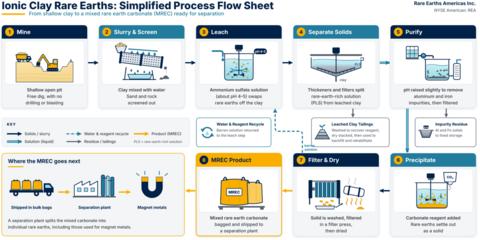
Figure 1 – Simplified process flow sheet for ionic clays, not specifically with respect to Alpha. See Appendix C for additional details.
In the SGS tests, leach recovery of rare earth elements excluding cerium (“TREE-Ce”) reached 40%, compared with the 27% recovery assumption in the Company’s Technical Report Summary (“TRS”), representing a 48% relative increase. The comparison is not like-for-like: the SGS work and TRS assumption reflect different test conditions. Put simply, the rare earth content of the clay has not changed, but the laboratory process brought more of those elements into solution. Higher leach recovery could ultimately mean more recoverable material from the same mined clay, provided subsequent process steps and larger-scale testing support it. This is not an increase in Alpha’s reported mineral resource.
Development pathway and upcoming catalysts. Completion of the IA in Q1 2027 is REA’s next identified Alpha milestone. The assessment is intended to help determine the scope of subsequent engineering, additional metallurgical testing, environmental and permitting work, and potential financing requirements. No construction or first-production date has been established, and any further development schedule remains subject to technical results and corporate decisions.
Test work summary. SGS evaluated the two reagents most commonly used for ionic clay deposits, ammonium sulfate and sodium chloride (table salt), across a range of reagent concentrations and pH conditions (Appendix A: Figures 2-9). The test work focused on the leaching stage of the simplified flowsheet shown in Figure 1.
A composite sample comprising 80 individual samples, with 20 samples sourced from each of the Rio Preto, Sapucaia, Rio das Pombas, and Nova Canaã deposits, was used for the program. The composite assayed 1,121 ppm TREE (818 ppm TREE-Ce) in the -1 mm fraction that served as feed for the leaching tests (Table 1). Additional variability testing is necessary before the results can be applied across the resource.
The tested composite contained an attractive mix of magnet and heavy rare earths: neodymium (Nd), praseodymium (Pr), dysprosium (Dy) and terbium (Tb) account for approximately 37% of its TREE-Ce content, while heavy rare earths account for approximately 29%. These percentages relate to the SGS test composite and should not be interpreted as the composition of the entire resource.
SGS test work achieved a TREE-Ce leach recovery of approximately 40%. Initial testing at 20% solids established the preferred reagent (ammonium sulfate), concentration (0.25 M), and pH (4.0), with subsequent optimization work showing that the highest recovery was achieved in a 10-minute leach at 40% solids.
The 40% figure relates only to the leaching step, not overall recovery into mixed rare earth carbonate (“MREC”). Additional losses can occur during impurity removal and product production (see Figure 1). Since the results come from one laboratory composite, performance may differ by deposit or at commercial scale. The IA will assess the implications of the SGS results alongside other technical and economic assumptions; there is no assurance that improved leach recovery will translate into better project economics. The Company expects to continue leach optimization, variability testing and downstream process evaluation as it advances the IA.
Why ionic clays matter. In ionic adsorption clays, some rare earths are attached to clay surfaces rather than locked in hard rock. This can allow extraction with relatively mild solutions and potentially simpler processing, subject to deposit-specific testing and operating conditions.
Why ammonium sulfate. Although sodium chloride produced marginally higher recoveries in some tests, ammonium sulfate was selected because its established use in ionic clay leaching and the potential water-management and corrosion challenges of chloride-bearing solutions may offer a more practical overall processing route. Reagent consumption, recycling, effluent management and costs require further evaluation.
Why moderate acidity. Tests indicated a potential tradeoff: stronger acidity may dissolve more rare earths but can also draw more unwanted metals into solution and increase reagent needs. Moderately acidic conditions appeared to offer a better balance in this early work. Final process conditions have not been established. Detailed test data appear in Appendix A.
About Rare Earths Americas
Rare Earths Americas, Inc. is an exploration-stage company advancing a diversified portfolio of critical mineral projects focused on rare earths in the United States and Brazil. The Company is focused on rare earth assets that contain heavy rare earths, including dysprosium and terbium, which are critical to high-performance permanent magnets and for which supply has historically been concentrated in China and Myanmar. In Brazil, REA is advancing three rare earth projects (Alpha, Constellation and Homer-A) across distinct rare earth districts, giving the Company multiple potential development pathways. Constellation, Alpha and Shiloh are the Company’s three material projects. Alpha and Constellation each host inferred mineral resources, giving REA significant resource scale. The portfolio is intended to provide flexibility in development sequencing and capital allocation as technical studies advance. In the United States, REA is exploring the Foothills Rare Earths District in Georgia, which the Company believes has the potential to become a new domestic source of rare earths. Rare earth elements are essential to advanced industries including robotics, electric vehicles, energy, defense and consumer electronics.
Qualified Persons: Leandro Coracini Ollita, Qualified Person registered with the Brazilian Commission for Resources and Reserves (CBRR), Registration No. 023160, who is a “qualified person” within the meaning of Item 1300 of Regulation S-K (“S-K 1300”), has reviewed and approved the disclosure of technical information contained in this press release.
Forward-Looking Statements & Technical Notes
This communication contains forward-looking statements within the meaning of Section 27A of the Securities Act of 1933, as amended, and Section 21E of the Securities Exchange Act of 1934, as amended. When used in this communication, the words “plan,” “target,” “anticipate,” “believe,” “could,” “designed to,” “estimate,” “evaluate,” “expect,” “focused on,” “intend,” “may,” “opportunities,” “potential,” “seeks,” “should,” “will,” “would” and similar expressions are intended to identify such forward-looking statements. Any express or implied statements contained in this communication that are not statements of historical fact may be deemed to be forward-looking statements.
Forward-looking statements in this communication include, but are not limited to: the scope, timing and completion of the IA for the Alpha Project, including the Company’s target of completing the IA in the first quarter of 2027; the expected incorporation of the SGS leach test results into the IA; expectations that higher leach recoveries could support higher overall metallurgical recoveries; the selection of ammonium sulfate and moderate-acidity leach conditions, and their potential effects on impurity levels, reagent consumption and downstream processing; the scope and timing of planned testwork, including leach kinetics, solids-content, variability and larger-scale leach and purification testwork; expectations regarding potential mine plans, production rates, metallurgical performance, infrastructure, permitting and preliminary project economics; the potential demand for, and strategic significance of, magnet and heavy rare earths, including supply from outside China; and the Company’s strategic objectives relating to the exploration and development of critical mineral opportunities.
The Alpha Project has an inferred mineral resource of 202 million tonnes at 1,520 ppm TREO at a 1,000 ppm TREO cut-off, effective October 31st, 2025. Inferred mineral resources are subject to a high degree of geological uncertainty and may not be converted to mineral reserves. The Company has not completed the IA and has not made a development or construction decision for Alpha. There can be no assurance that the IA will demonstrate economic viability or that the project will advance to development.
The leach test results described in this communication were obtained from a single composite sample under laboratory conditions and measure only the leach step. They do not reflect overall process recovery, and additional losses are expected in subsequent processing steps. The SGS results and the recovery assumed in the Company’s Technical Report Summary were produced under different test conditions and are not directly comparable. Results may not be representative of the Alpha mineral resource as a whole, and recoveries may vary across deposits and may not be achieved at larger scale or in commercial operation. There is no certainty that the IA will be completed on the anticipated schedule or within budget, that additional technical work will confirm favorable metallurgical, mining, infrastructure, environmental or permitting assumptions, or that Alpha will advance toward development. Any production, cost or economic expectations remain subject to completion of the IA and subsequent technical studies. Mineral resources that are not mineral reserves do not have demonstrated economic viability.
These forward-looking statements are based on assumptions and expectations that may not prove to be accurate and are subject to numerous risks and uncertainties that could cause actual results to differ materially from those described in such statements. These risks and uncertainties include, among others: geological, technical and interpretation risks; uncertainty associated with inferred mineral resources; uncertainties relating to metallurgical recovery, including variability across the deposits, scale-up from laboratory testing, solid-liquid separation and impurity removal; reagent availability and cost, including ammonium sulfate and sulfuric acid; water, effluent and environmental management, including the management of ammonium; uncertainties relating to mining methods, infrastructure, permitting and project economics; the possibility that technical studies may not achieve their objectives or may take longer or cost more than anticipated; fluctuations in rare earth commodity prices, including dysprosium, terbium, neodymium and praseodymium; changes in Chinese export controls and other trade policies; regulatory, environmental and permitting risks in Brazil; political, economic and trade-policy risks in Brazil and the United States; currency exchange-rate fluctuations between the U.S. dollar and the Brazilian real; availability of financing on acceptable terms; the Company’s need for substantial additional capital; market conditions; and general economic, political and business risks. The foregoing list is not exhaustive.
Investors are cautioned that mineral resources, particularly inferred mineral resources, are subject to significant uncertainty and do not constitute mineral reserves or demonstrate economic viability. The results of the IA and future technical work may differ materially from current expectations.
For additional information regarding factors that may cause actual results to differ materially from those indicated in our forward-looking statements, we refer you to the risk factors included in the Company’s Rule 424(b)(4) Prospectus filed on May 7, 2026, the Company’s Quarterly Reports on Form 10-Q for the quarters ended March 31, 2026 and June 30, 2026, filed on June 4, 2026 and August 11, 2026, respectively, and future filings, which are or will be available at www.sec.gov. We caution investors not to place undue reliance on the forward-looking statements contained in this communication. These statements speak only as of the date of this communication, and we undertake no obligation to update or revise these statements, whether as a result of new information, future events or otherwise, except as may be required by law.
This press release does not constitute an offer to sell or the solicitation of an offer to buy any securities.
Appendix A – Additional Information for SGS Leach Tests
| Ionic Clay Feed (Chemical Composition) | Leach Condition | Pregnant Leach Solution (Chemical Composition) | ||||||||
| Rare Earths | Initial slurry pH |
5.80 |
Rare Earths | |||||||
| La |
274.40 |
ppm | Final slurry pH |
4.00 |
La |
58.13 |
ppm | |||
| Ce |
302.90 |
ppm | pH adjustment |
H2SO4 |
Ce |
8.80 |
ppm | |||
| Pr |
60.72 |
ppm | Leaching time |
10 |
min | Pr |
17.21 |
ppm | ||
| Nd |
212.70 |
ppm | Solids content |
40 |
wt.% | Nd |
65.40 |
ppm | ||
| Sm |
36.00 |
ppm | Ammonium sulfate [(NH4)2SO4] |
0.25 |
M | Sm |
10.34 |
ppm | ||
| Eu |
5.81 |
ppm | Eu |
1.62 |
ppm | |||||
| Gd |
29.90 |
ppm | Gd |
8.88 |
ppm | |||||
| Tb |
4.32 |
ppm | Tb |
1.25 |
ppm | |||||
| Dy |
26.62 |
ppm | Dy |
7.40 |
ppm | |||||
| Ho |
5.06 |
ppm | Ho |
1.55 |
ppm | |||||
| Er |
14.07 |
ppm | Er |
4.42 |
ppm | |||||
| Tm |
1.97 |
ppm | Tm |
0.60 |
ppm | |||||
| Yb |
12.60 |
ppm | Yb |
3.40 |
ppm | |||||
| Lu |
1.69 |
ppm | Lu |
0.49 |
ppm | |||||
| Y |
132.00 |
ppm | Y |
38.52 |
ppm | |||||
| TREE |
1,120.76 |
ppm | TREE |
227.98 |
ppm | |||||
| TREE_Ce |
817.86 |
ppm | TREE_Ce |
219.19 |
ppm | |||||
| HREE |
234.04 |
ppm | HREE |
68.12 |
ppm | |||||
| LREE_Ce |
583.82 |
ppm | LREE_Ce |
151.07 |
ppm | |||||
| MREE |
304.36 |
ppm | MREE |
91.26 |
ppm | |||||
| Impurities | Impurities | |||||||||
| Al |
93,890.00 |
ppm | Al |
18.30 |
ppm | |||||
| Fe |
47,910.00 |
ppm | Fe |
1.28 |
ppm | |||||
| Ca |
572.00 |
ppm | Ca |
36.02 |
ppm | |||||
| Mg |
3,498.00 |
ppm | Mg |
60.57 |
ppm | |||||
| Ti |
4,556.00 |
ppm | Ti |
3.20 |
ppm | |||||
| P |
524.00 |
ppm | P |
2.56 |
ppm | |||||
| Na |
1,335.00 |
ppm | Na |
14.39 |
ppm | |||||
| K |
31,546.00 |
ppm | K |
49.00 |
ppm | |||||
| Mn |
620.00 |
ppm | Mn |
5.11 |
ppm | |||||
| Nb |
43.30 |
ppm | Nb |
0.12 |
ppm | |||||
| Th |
46.00 |
ppm | Th |
0.12 |
ppm | |||||
| U |
11.38 |
ppm | U |
0.15 |
ppm | |||||
| SiO2 |
65.20 |
% |
SO42- |
22,227.35 |
ppm | |||||
Table 1 – Feed Composition, Leach Conditions and Leach Solution Grades
Note:
- TREE includes: La, Ce, Pr, Nd, Sm, Eu, Gd, Tb, Dy, Ho, Er, Tm, Yb, Lu, Y
- TREE_Ce includes: La, Pr, Nd, Sm, Eu, Gd, Tb, Dy, Ho, Er, Tm, Yb, Lu, Y
- HREE includes: Eu, Gd, Tb, Dy, Ho, Er, Tm, Yb, Lu, Y
- LREE_Ce includes: La, Pr, Nd, Sm
- MREE includes: Pr, Nd, Tb, Dy
Note: for additional drilling information associated with this release, see the Supplemental Technical Data section of the REA investor website.
Appendix B
The following Appendix B section provides general background information on rare earths. This information is derived from publicly available third-party sources.
None of this information is intended as, and none should be construed as, an assessment of the economic viability of the Alpha Project or any other REA project.
What are Rare Earths?
Rare earth elements are a group of 17 specialty metals critical to a wide range of advanced and everyday technologies. They are used in high-performance permanent magnets, particularly neodymium-iron-boron (NdFeB) magnets, which enable high strength and efficiency in applications such as robotics, electric vehicles, defense systems, wind turbines, and consumer electronics. In simple terms, motion generated by electricity is often powered by NdFeB magnets, making rare earths essential inputs in everyday items, from the motor that raises and lowers a car window to the motors used in drones and humanoid robots.
Of the 17 rare earth elements, neodymium (Nd), praseodymium (Pr), dysprosium (Dy), and terbium (Tb) are the key materials used in high-performance permanent magnets. Dy and Tb are particularly valuable due to their ability to enhance magnet performance at high temperatures.
According to Adamas Intelligence, China accounts for over 90% of global Dy and Tb production. This concentration has increased the strategic importance of developing new rare earth projects in other jurisdictions to support supply chain diversification and long-term demand growth.
Appendix C
What are Ionic Adsorption Clays (IAC)? Why are they important source of heavy rare earths?
In general, and not specifically with respect to Alpha, IAC deposits are a source of heavy rare earth elements, including DyTb, which are critical to high-performance permanent magnets used in electric vehicles, robotics, drones, wind turbines and defense applications. China and Myanmar have historically supplied most of the world’s heavy rare earths from IAC deposits and, according to Adamas Intelligence, account for more than 90% of global DyTb production.
IAC deposits form through a two-stage natural concentration process. First, rare earth elements become enriched within alkaline rocks through magmatic fractionation, a geological process that concentrates rare earths as magma cools and crystallizes. Over millions of years, intense tropical weathering driven by rainfall, groundwater circulation and chemical alteration breaks down these rocks, removing more mobile elements while leaving the relatively immobile rare earth elements behind. As a result, rare earths become naturally concentrated within the weathered profile and become adsorbed onto the surface of clay particles.
Rare earth-enriched source rocks, combined with prolonged tropical weathering, have created ionic clay systems with attractive grades and significant concentrations of valuable magnetic rare earth elements, including neodymium, praseodymium, dysprosium and terbium.
Unlike conventional hard-rock rare earth deposits, where rare earths remain locked within minerals such as monazite and bastnaesite and must be liberated through crushing, grinding and beneficiation, rare earths in IAC deposits are weakly bound to clay particles. Consequently, they can often be recovered using relatively mild leaching solutions, such as ammonium sulfate.
While IAC deposits typically contain lower rare earth grades than many hard-rock deposits, commonly ranging from 500 ppm to 3,000 ppm TREO, they remain highly attractive due to several characteristics:
- Mineralization is typically located near surface and can often be mined using simple open-pit methods and conventional excavator fleets.
- The clay generally requires little or no crushing, grinding or beneficiation before processing.
- Rare earths can often be extracted using comparatively mild and lower-cost reagents.
- IAC deposits are frequently enriched in high-value heavy rare earth elements, including dysprosium and terbium.
- IAC deposits may contain lower levels of deleterious elements and, depending on mineralogy and location, may contain lower levels of naturally occurring radioactive materials than some hard-rock rare earth deposits; actual conditions vary by deposit.
- The relatively simple mining methods and limited physical disturbance associated with some clay extraction operations may contribute to a smaller environmental footprint and may support a more streamlined permitting process compared with some conventional mining projects, but permitting remains project-specific. Environmental conditions and permitting requirements for Alpha must be assessed on a project-specific basis.
- These characteristics may allow for simpler processing flowsheets and reduced handling requirements, subject to project-specific mineralogy and process design.
View source version on businesswire.com: https://www.businesswire.com/news/home/20261102849004/en/
Media gallery
