Cybersecurity Awareness Month Brings a Free Large-Print Book for a Safer Online World
From UtilForge.org, a 2026 Champion of the campaign run by the Cybersecurity and Infrastructure Security Agency and the
Press Release Disclaimer: This is a press release distributed through the XPR Media network. It has not been independently verified by our newsroom.

From UtilForge.org, a 2026 Champion of the campaign run by the Cybersecurity and Infrastructure Security Agency and the National Cybersecurity Alliance.
LONDON, UNITED KINGDOM, October 20, 2026 /EINPresswire.com/ — Cybersecurity Awareness Month is led in the United States by the Cybersecurity and Infrastructure Security Agency and the National Cybersecurity Alliance, a non-profit, under this year’s theme, “Don’t Make It Easy for Them”. European Cybersecurity Month runs across the European Union in the same month, coordinated by the European Union Agency for Cybersecurity, focused this year on the workplace.
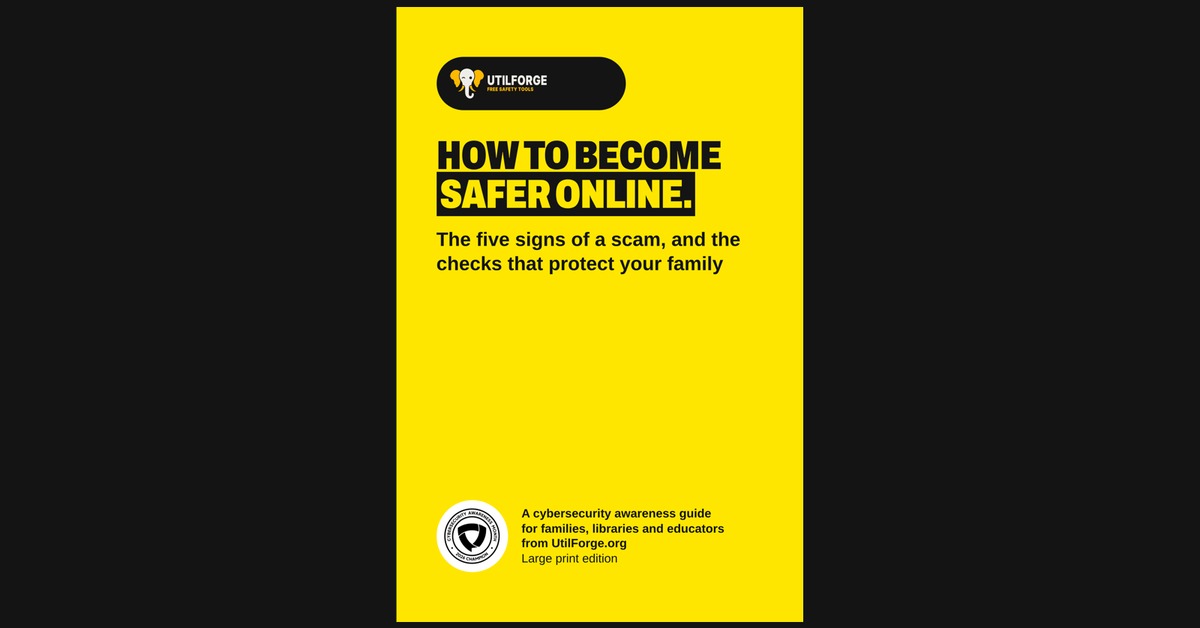
UtilForge.org has published How to Become Safer Online, a free cybersecurity awareness book for families, libraries and educators, to follow the free online safety tools made available worldwide on 1 October 2026. The book is set in 16-point type, in line with the large-print guidance of the Royal National Institute of Blind People, the United Kingdom’s sight loss charity, and anyone may print, photocopy and share it without asking permission.
In November 2025 the International Telecommunication Union, the United Nations agency for digital technologies, reported that about 6 billion people use the internet and that 2.2 billion are still offline, 96 per cent of them in low- and middle-income countries. UtilForge.org holds that every person who comes online should be able to bank, study, apply for work, browse and stay in touch with family in safety. In April 2026 the Federal Bureau of Investigation reported that Americans lost $20.9 billion to online crime in 2025, 26 per cent more than in 2024, and that people aged 60 and over reported almost $7.75 billion of those losses. In May 2026 the European Union Agency for Fundamental Rights found that one person in four in the European Union has been a victim of online fraud, and that only 15 per cent of victims reported it to the police.
In the book, Part One explains the five steps that most scams follow, and why spotting any one of them is reason enough to stop and check. Part Two covers the common frauds of 2026, each with a free check. Part Three is for educators and for the person a family turns to, with a suggested forty-five-minute session plan for a kitchen table or a library and a chapter on agreeing a family safe word. Part Four is for anyone who has already lost money or details, starting with the first phone call and listing where to report fraud country by country, a list also kept at https://utilforge.org/official-help which links to guidance from the Cybersecurity and Infrastructure Security Agency and the European Union Agency for Cybersecurity. Part Five covers blacking out a document properly, what to paste into an artificial intelligence assistant, and the hidden instructions that web pages and emails can carry.
A printed copy can reach people who share a single phone, have a limited connection or are not online, and can be handed out at a library, community centre, care home or careers office. Every tool and check the book describes runs free at UtilForge.org on the reader’s own phone or computer, and what the reader types stays on that device.
“Every warning passed on, and every safety tool shared with a family member, a classmate or a colleague, widens access to online safety,” said Lindsay McDonald, spokesperson for UtilForge.org. “A safer online world is built one conversation at a time, by the librarian, the careers adviser, the neighbour and the family member everyone reaches out to. We hope this book encourages others to do more within their own spheres of influence, and contributes to broader digital inclusion.”
How to Become Safer Online is free to download at https://utilforge.org/book. Any organisation is welcome to print the book for the people and community it serves.
About UtilForge.org
UtilForge.org makes free cybersecurity tools and practical guides that run on people’s own phones and computers, helping them check messages, job offers, payments, documents and the use of artificial intelligence before they act. UtilForge.org is a registered 2026 Champion of Cybersecurity Awareness Month, a programme of the National Cybersecurity Alliance, and takes part in European Cybersecurity Month independently.
Lindsay McDonald
Invictus Communications
lindsay@invictuscomm.com
Visit us on social media:
LinkedIn
YouTube
How to Become Safer Online: The Five Steps Explained
Legal Disclaimer:
EIN Presswire provides this news content “as is” without warranty of any kind. We do not accept any responsibility or liability
for the accuracy, content, images, videos, licenses, completeness, legality, or reliability of the information contained in this
article. If you have any complaints or copyright issues related to this article, kindly contact the author above.

Media gallery