Switchable Bright-Field & Edge-Enhanced Imaging with a Polarization-Multiplexed Metalens
Announcing a new publication from Opto-Electronic Sciences; DOI 10.29026/oes.2026.260044. SHANNON, CLARE, IRELAND,
Press Release Disclaimer: This is a press release distributed through the XPR Media network. It has not been independently verified by our newsroom.

Announcing a new publication from Opto-Electronic Sciences; DOI 10.29026/oes.2026.260044.
SHANNON, CLARE, IRELAND, October 5, 2026 /EINPresswire.com/ — Announcing a new publication from Opto-Electronic Sciences; DOI 10.29026/oes.2026.260044.
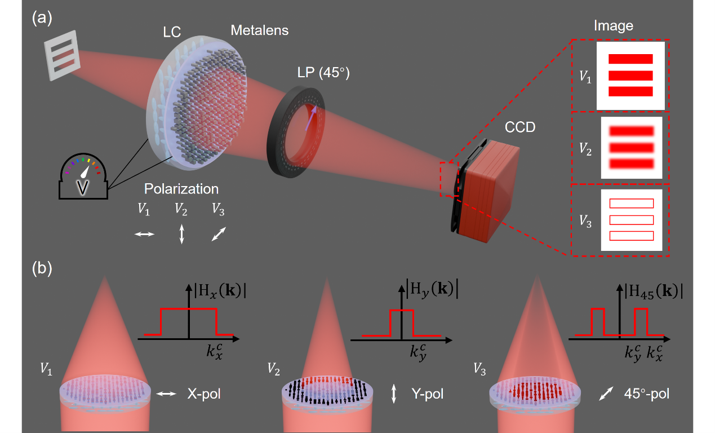
Researchers have proposed a liquid-crystal-integrated polarization-multiplexed metalens that electrically selects two bright-field states and an interference-synthesized edge-enhanced state. The two polarization channels share a focal plane but have unequal effective apertures and different spatial-frequency bandwidths. Under 45°-polarized illumination a followed by a 45° analyzer, a designed π-phase offset coherently cancels shared low-frequency components while retaining higher spatial frequencies. Experiments at 635 nm validate focusing, resolution-target imaging, biological imaging, and voltage-controlled switching without digital post-processing.
In an optical imaging system, the transfer function determines which spatial-frequency components of the object field reach the image plane and with what amplitude and phase. Engineering this function is essential for visualizing transparent or weakly absorbing specimens, whose internal boundaries may produce little intensity contrast under bright-field illumination. Dark-field, Zernike phase-contrast and differential-interference-contrast microscopy create contrast by modifying the pupil function or interfering selected field components. These methods rely on stops, phase plates, birefringent prisms and accurately aligned conjugate planes, which complicate miniaturization and integration.
Metasurfaces provide a planar platform for engineering amplitude, phase and polarization and have been used for spatial differentiation, edge enhancement and related analog image operations. Most metasurface image processors implement each prescribed transfer function in a separate optical channel. Multiplexed designs may assign different responses to polarization, wavelength or angle, but the constituent channels are generally designed and read out independently. Their coherent interaction has rarely been used to generate a transfer function beyond those directly encoded in the individual channels. The present work makes that coherent interaction part of the transfer-function design. A voltage-controlled liquid-crystal retarder selects X-, Y- or 45°-linear polarization at a polarization-multiplexed metalens. The X- and Y-polarized channels share a nominal focal plane but have different effective apertures and therefore different cutoff spatial frequencies. X- or Y-polarized input accesses the corresponding bright-field response. With 45°-polarized input and a 45° analyzer, the two complex fields are projected onto the same polarization basis. Within the spatial-frequency range transmitted by both channels, a designed relative phase difference of π makes their field contributions interfere destructively. Frequencies transmitted only by the larger-aperture X-polarized channel are retained, so the resulting transfer function enhances object boundaries. Thus, two encoded polarization channels provide three voltage-selectable imaging responses without moving the meta-device or applying digital post-processing.
The research group of Prof. Junsuk Rho from Pohang University of Science and Technology (POSTECH), in collaboration with the groups of Prof. Yuchuan Shao from the Shanghai Institute of Optics and Fine Mechanics (SIOM), Chinese Academy of Sciences, and Prof. Trevon Badloe from Korea University, introduces a liquid-crystal-integrated polarization-multiplexed metalens that enables two bright-field imaging states and one interference-synthesized edge-enhanced state. The metalens consists of rectangular hydrogenated amorphous silicon (a-Si:H) nanopillars on a silica (SiO₂) substrate and has a nominal focal length of 800 μm. Its two orthogonal polarization channels are designed to be cofocal but have effective aperture diameters of D_x = 570 μm and D_y = 120 μm, corresponding to numerical apertures of approximately 0.336 and 0.075. The unequal apertures give the two channels different spatial-frequency cutoffs. Within their overlapping aperture, the meta-atom design imposes a relative phase difference of π between the two channels to establish the required interference condition.
With X- or Y-polarized input, the corresponding channel forms a conventional bright-field image. Under 45°-polarized illumination followed by a 45° analyzer, the two transmitted fields are projected onto a common polarization basis and interfere coherently. Low-frequency components transmitted by both channels acquire approximately opposite phases and are suppressed, while higher spatial frequencies supported by the larger X-polarized aperture remain. This coherent field difference produces the edge-enhancing transfer-function response. The third response thus arises from interference between the two encoded channels rather than from a separately encoded optical channel. The voltage-controlled liquid-crystal retarder selects the input polarization at the metalens, allowing three calibrated voltages to address the three imaging states without moving the optical element.
Experimental characterization at 635 nm produced focal-spot full widths at half maximum of 1.2 μm, 4.8 μm and 1.1 μm for the X-polarized, Y-polarized and 45°-polarized states, respectively. The measured focusing efficiencies were 43%, 36% and 24%. The lower efficiency in the 45° state arises partly from the intended cancellation of shared low-frequency content. Imaging of a USAF 1951 target confirmed the distinct resolution ranges of the two bright-field channels and the paired-edge contours generated by the synthesized state. A benchmark meta-device with the same focal length and aperture geometry but without the designed phase relationship retained the two bright-field responses yet failed to reproduce the 45°-polarized edge-enhanced response, confirming that the designed relative phase relationship is necessary for the interference-synthesized response.
The team further imaged an earthworm cross-section, onion epidermal cells and a cross-section of a young Ligustrum stem. The X-polarized state recorded conventional bright-field views, whereas the 45° state accentuated cellular and tissue boundaries directly in the optical domain, without digital post-processing. The concept therefore offers a route to compact, electrically selectable, label-free contrast enhancement. The proof-of-concept device is optimized at 635 nm. In particular, the edge-enhanced state requires sufficiently high spatial coherence, a sufficiently narrow spectral bandwidth and adequate matching of the two channel fields. Wavelength shifts, fabrication errors, defocus and off-axis incidence can reduce cancellation quality. Future improvements may combine higher-transmission meta-atoms, lower-loss liquid-crystal and polarization components, and dispersion engineering to broaden the usable wavelength range and improve efficiency.
This work was financially supported by the POSCO-POSTECH-RIST Convergence Research Center program funded by POSCO, and the National Research Foundation (NRF) grants (RS-2026-25507992, RS-2025-17492968, RS-202502317602, RS-2025-02217649, RS-2024-00462912, RS-2024-00356928) funded by the Ministry of Science and ICT (MSIT) of the Korean government. This research was also supported by a grant of Korean ARPA-H Project through the Korea Health Industry Development Institute (KHIDI), funded by the Ministry of Health & Welfare, Republic of Korea (Grant number: RS-2025-25454431). T.B. acknowledges the NRF grant (RS-2026-25598896) funded by the MSIT of the Korean government, and the ANCHOR program through the Sejong ANCHOR Center, funded by the Ministry of Education (MOE) and the Sejong City of the Korean government. (2026-ANCHOR-08-001).
Keywords: polarization-multiplexed metalens, transfer-function engineering, interference, tunable
liquid crystals
# # # # # #
Junsuk Rho is the Yeonsan Endowed Chair Professor and the Mu-Eun-Jae Endowed Chair Professor at Pohang University of Science and Technology (POSTECH), where he holds appointments in the Departments of Mechanical Engineering, Chemical Engineering, and Electrical Engineering, as well as the School of Quantum Science and Technology. He also directs the POSCO-POSTECH-RIST Convergence Research Center for Flat Optics and Metaphotonics. He received his B.S. in Mechanical and Aerospace Engineering from Seoul National University in 2007, his M.S. in Mechanical Science and Engineering from the University of Illinois Urbana-Champaign in 2008, and his Ph.D. in Mechanical Engineering and Nanoscale Science and Engineering from the University of California, Berkeley, in 2013. Before joining POSTECH in 2014, he conducted postdoctoral research in the Materials Sciences Division and the Molecular Foundry at Lawrence Berkeley National Laboratory and subsequently served as a Ugo Fano Fellow and principal investigator in the Nanoscience and Technology Division and the Center for Nanoscale Materials at Argonne National Laboratory. His research focuses on metamaterials, metasurfaces, nanophotonics, nanofabrication and nanomanufacturing, flat optics, optical imaging, displays, and photonic computing. He was named a Clarivate Highly Cited Researcher in 2023 and 2024, received the 2024 ACS Nano Lectureship and Korea’s Scientist of the Month award, and was elected a SPIE Fellow in 2026. Personal website: https://photonics.postech.ac.kr/welcome
Trevon Badloe is currently an assistant professor at Korea University – Sejong Campus, South Korea in the Department of Electronics and Information Engineering. He obtained his Ph.D. in Mechanical Engineering at Pohang University of Science and Technology (POSTECH), South Korea (2023) under the guidance of Prof. Junsuk Rho, and conducted postdoctoral research at the Graduate School of AI, POSTECH, South Korea as a PIURI fellow. Before moving to Korea, Trevon received his MPhys (Master of Physics) degree at the University of Sheffield, in the Department of Physics and Astronomy (2012). His research interests are in nano-optics, metaphotonics, and their convergence with AI for inverse design, optical sensing, imaging, and computational optics. Personal website: https://metai.korea.ac.kr/
Yuchuan Shao is a professor and doctoral supervisor and a deputy director at SIOM. He obtained his Ph.D. from the University of Nebraska–Lincoln, then worked at Yale University, the University of North Carolina at Chapel Hill and Apple before joining SIOM. His research spans optoelectronic materials and devices, perovskite semiconductors, thin-film optics, metasurface and optical imaging.
# # # # # #
Opto-Electronic Science (OES) is a peer-reviewed, open access, interdisciplinary and international journal. OES has been indexed in ESCI, Scopus, DOAJ, and CAS databases, with a Scopus CiteScore Tracker of 30.7 for 2025 and a JCR Immediate Impact Factor of 26.
# # # # # #
More information: https://www.oejournal.org/oes
Editorial Board: https://www.oejournal.org/oes/editorialboard/list
All issues available in the online archive (https://www.oejournal.org/oes/archive)
Submission of OES may be made using ScholarOne (https://mc03.manuscriptcentral.com/oes)
CN 51-1800/O4
ISSN 2097-0382
Contact Us: oes@ioe.ac.cn
Twitter: @OptoElectronAdv (https://twitter.com/OptoElectronAdv?lang=en)
WeChat: OE_Journal
# # # # # #
Li XT, Seong J, Kim Y et al. Electrically switchable bright-field and interference-synthesized edge-enhanced imaging with a polarization-multiplexed metalens. Opto-Electron Sci 5, 260044 (2026). DOI: 10.29026/oes.2026.260044
Opto-Electronic Science Editorial Office
Opto-Electronic Science
oes@ioe.ac.cn
Legal Disclaimer:
EIN Presswire provides this news content “as is” without warranty of any kind. We do not accept any responsibility or liability
for the accuracy, content, images, videos, licenses, completeness, legality, or reliability of the information contained in this
article. If you have any complaints or copyright issues related to this article, kindly contact the author above.

Media gallery