Tokyo International Conference on Breast Cancer in Young Women Highlights Survivor Voices, Research, and Advocacy
Survivors, advocates, clinicians, and scientists from 14 countries gathered in Tokyo to advance timely education,
Press Release Disclaimer: This is a press release distributed through the XPR Media network. It has not been independently verified by our newsroom.
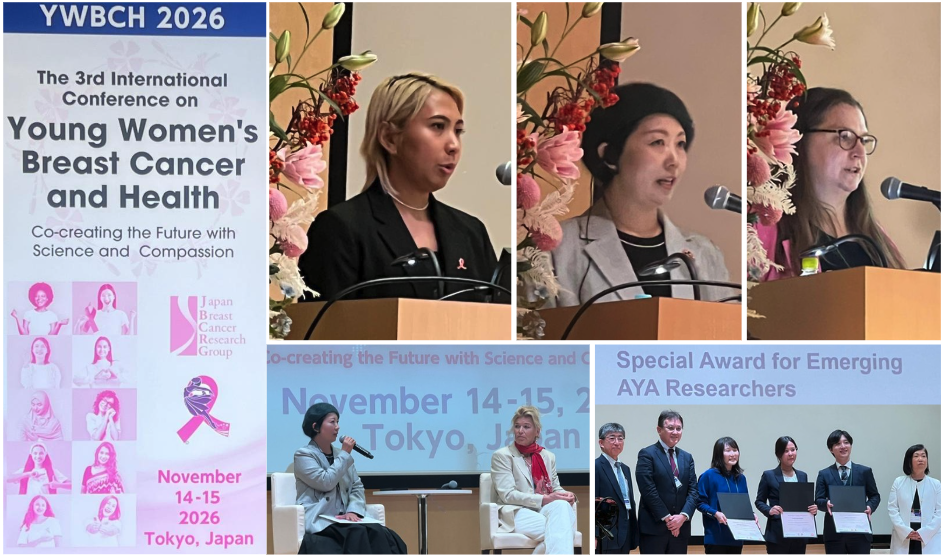

Survivors, advocates, clinicians, and scientists from 14 countries gathered in Tokyo to advance timely education, evaluation, and research on breast health.
DENVER, CO, UNITED STATES, November 23, 2026 /EINPresswire.com/ — Two breast cancer survivors, Michelle Basco and Rachelle Panitz, gave the conference’s opening and closing presentations, putting young women’s lived experience at the center of the scientific program.
Michelle Basco, a breast cancer survivor and advocate in Japan, shared her experience with triple-negative breast cancer in the opening Peer Voice session of the 3rd International Conference on Young Women’s Breast Cancer and Health. Rachelle Panitz of SoBrave, Australia, who survived pregnancy-associated breast cancer, gave the final presentation before the formal closing remarks. She discussed how misconceptions about breast cancer risk among young women can create barriers to care. Their experiences framed two days of discussion among survivors, advocates, clinicians, and scientists from 14 countries.
Chikako Shimizu, MD, PhD, opened the meeting on November 14–15, welcoming participants to the event co-hosted by the Breast Cancer in Young Women Foundation (BCYW Foundation) and the Japan Breast Cancer Research Group (JBCRG). Conference co-chair Rakesh Kumar, PhD, founder of BCYW Foundation and founding scientific director of the Young Women’s Breast Cancer Research Institute (YWBCRI), reviewed the Foundation’s progress in targeted education and international collaboration and highlighted open research questions the BCYWF team is working to address. He also outlined the work ahead: reaching young women earlier with practical breast health information and investigating the biology that precedes a breast cancer diagnosis. ,Conference co-chair Shigehira Saji, MD, PhD, representing JBCRG, delivered the formal Closing Remarks.
THE SCIENCE OF BREAST CANCER IN YOUNG WOMEN
The Tokyo program explored why breast cancer develops in young women and how care can better reflect the stage of life at diagnosis. Kouya Shiraishi presented genomic perspectives on early-onset breast cancer, Paola Marignani examined chronic, low-dose exposure to endocrine disruptors, and Kousuke Kawaguchi explored how aging may shape the tumor immune environment. In a special lecture, Michael Gnant discussed the endocrine environment and its relevance to treatment. The program also featured a Nobel Prize Lecture by Aaron Ciechanover.
Clinical sessions considered treatment options for young patients with topics including triple-negative breast cancer, decisions about systemic treatment intensity, and the long-term effects of surgery and radiotherapy. Ellen Warner discussed inherited predisposition and its implications for patients and relatives; Samantha Heller addressed breast imaging in young women; and Tetsu Hayashida presented the development of MAIKO, an AI chatbot, and its potential role in patient care. The conference featured more than 30 scientific posters, providing researchers with an opportunity to share ongoing work with clinicians, survivors, and advocates. The Special Award for Emerging AYA Researchers recognized emerging investigators in adolescent and young adult (AYA) cancer research.
PREGNANCY, FERTILITY, AND LIFE AFTER DIAGNOSIS
Two distinct questions drew attention in Tokyo. Shari Goldfarb discussed pregnancy-associated breast cancer—the topic Panitz raised during the closing advocacy session—as well as gonadal dysfunction and related supportive care needs. Monica Ruggeri presented updated findings from the international POSITIVE trial, which examines whether temporarily interrupting endocrine therapy allows women to try to become pregnant after hormone receptor–positive breast cancer. Nao Suzuki discussed the development of oncofertility care in Japan.
A session co-chaired by Yutaka Yamamoto and Monica Ruggeri explored how clinical research can better serve young women. Hee Jeong Kim discussed interventional study design; Marie Jeanne Vrancken Peeters examined methods for measuring quality of life among adolescent and young adult survivors; and Mie Mifune of Japan’s Pink Ring Young Breast Cancer Support Community shared the patient perspective on access to research. Vrancken Peeters also discussed breast reconstruction after mastectomy. Stacy Lewis of the Young Survival Coalition highlighted the care and support needs of young women living with advanced or metastatic breast cancer.
JBCRG’s post-meeting release also highlighted responsibilities and decisions that treatment can disrupt, including work, career development, family life, and plans for children, and underscored the need for psychological support. The final advocacy session, co-chaired by Luís Costa and Naomi Sakurai, brought these concerns into a broader discussion of the financial burden of treatment, community advocacy across cultures, and access to high-quality oncology care.
Luís Costa, MD, PhD | Faculty of Medicine, University of Lisbon, Portugal
“A young woman who notices a breast change should know where to turn and be able to get an appointment. Education can help her take that first step. The responsibility then shifts to the health system to take her concern seriously and make sure cost, geography, or assumptions about her age do not delay evaluation.”
A SPECIAL SESSION WITH INNOVATORS – SUPPORTED BY THE ESTÉE LAUDER COMPANIES JAPAN
Pritzker Prize–winning architect Kazuyo Sejima delivered a keynote on how shared spaces can encourage people to meet and talk—a core principle for advancing medicine. In a panel moderated by Chikako Shimizu, Sejima discussed the value of spaces where people can speak openly about breast cancer, while Masakazu Toi emphasized the importance of integrating patient and community perspectives into research and care. James Aquilina described breast cancer education as a year-round effort and highlighted The Estée Lauder Companies Japan’s support for the POSITIVE trial. The panel connected a question young women bring to the clinic with the international research needed to answer it.
Masakazu Toi, MD, PhD | Tokyo Metropolitan Komagome Hospital, Japan
“In Tokyo, young women affected by breast cancer were part of the same conversation as the people who design studies and deliver care. Their experiences can change the questions we ask, the outcomes we measure, and the support we provide. Bringing those perspectives into research from the beginning is one of the most important things we can do together.”
BCYW FOUNDATION: PRIORITIES FOR EDUCATION, TIMELY CARE, AND RESEARCH
Through the Youth Council for Breast Health (YCBH), BCYWF will bring practical breast health education to campuses and communities, including outreach to pregnant and postpartum women. Survivors and advocates will help shape the education around the questions young women ask: What changes should I watch for? Where can I get them checked? What does my family history mean for me?
BCYWF and YWBCRI will work with clinical and community partners to identify where young women experience delays in having breast changes evaluated. They will also advocate for clinical studies to report how many young women participate, how they fare, and what outcomes affect their lives after diagnosis.
YWBCRI will study how breast cancer begins in young women. By comparing early changes in breast tissue across institutions and accounting for age and reproductive history, the Institute will investigate which changes could support earlier cancer detection and whether progression can be interrupted at some point.
Rakesh Kumar, PhD | Founder, BCYWF, and Founding Scientific Director, YWBCRI
“We founded the Breast Cancer in Young Women Foundation because young women deserve breast health education and research that reflect their stage of life. In Tokyo, survivors reminded us how much we can learn from them. What did they notice first? What was happening in their lives then? What do they wish we had asked? Their answers can strengthen our research and help us give young women the information they need to recognize breast changes and seek care promptly. As a scientist, I keep returning to one question: We know when a young woman was diagnosed, but when did her cancer begin? That question is central to the Young Women’s Breast Cancer Research Institute. We want to understand what happens in the breast before a change can be seen or felt, and whether that knowledge can help us detect cancer earlier.”
JOIN US IN AMSTERDAM FOR YWBCH 2027
The Breast Cancer in Young Women Foundation invites young women affected by breast cancer, survivors, advocates, clinicians, researchers, and community partners to the 4th International Conference on Young Women’s Breast Cancer and Health, to be held October 7–8, 2027, in Amsterdam, the Netherlands, in cooperation with the Netherlands Cancer Institute. We look forward to welcoming returning participants and first-time attendees. In Amsterdam, we will build on the work begun in Lisbon and advanced in New Delhi and Tokyo. Together, we will share new evidence, learn from young women’s experiences, and set priorities for research, clinical care, and targeted breast health education.
VIEW THE TOKYO 2026 SCIENTIFIC PROGRAM
https://procomu.jp/ywbch2026/scientific-program.html
ABOUT
The Breast Cancer in Young Women Foundation is a United States–based nonprofit dedicated to saving young women’s lives through targeted awareness, education, advocacy, early detection, and scientific research. It brings together clinicians, scientists, nurses, survivors, advocates, NGOs, and partners from 35 countries. It advances targeted awareness and research and highlights emerging advances in BCYW through its peer-reviewed, open-access journal, Young Women’s Breast Cancer and Health (YWBC, https://www.ovid.com/jnls/ywbc). One of the Foundation’s programs, the Youth Council for Breast Health (https://ycbh.org), promotes targeted awareness on educational campuses. Through evidence-based analysis, the Foundation works to improve outcomes and long-term survivorship for young women diagnosed with breast cancer.
The Young Women’s Breast Cancer Research Institute (YWBCRI), a research initiative of the BCYW Foundation, advances collaborative research on the earliest biological changes that precede breast cancer. It focuses on early breast biology, metabolic drivers, and opportunities to predict risk, prevent disease, and enable early intervention. The Institute aims to connect discoveries about how disease begins with approaches that could help identify and intercept risk earlier.
HELP CHANGE THE FUTURE OF BREAST CANCER IN YOUNG WOMEN: Your donation to the BCYW Foundation helps close gaps in awareness and early detection, advance research, amplify survivor voices, and bring trusted, freely accessible education to more communities worldwide. Support this mission—get involved and donate.
EDUCATIONAL DISCLAIMER:
These publications provide educational summaries and perspectives. For complete study data, methodology, and interpretation, readers should consult the cited original publications. This information is provided for educational purposes only and does not substitute for professional medical advice. Readers should consult a doctor with any concerns or questions.
Rakesh Kumar, Ph.D.
Breast Cancer in Young Women Foundation
bcywf@breastcancerinyoungwomen.org
Visit us on social media:
LinkedIn
Bluesky
Instagram
YouTube
X
Legal Disclaimer:
EIN Presswire provides this news content “as is” without warranty of any kind. We do not accept any responsibility or liability
for the accuracy, content, images, videos, licenses, completeness, legality, or reliability of the information contained in this
article. If you have any complaints or copyright issues related to this article, kindly contact the author above.

Media gallery