Vadzo Imaging Positions Falcon-1335MRS: Onsemi AR1335 13MP Monochrome USB 3.2 Gen 1 Camera for Pathology Imaging
The Falcon-1335MRS is an Onsemi AR1335 13MP Monochrome USB 3.2 Gen 1 Camera, and Vadzo Imaging is positioning it for
Press Release Disclaimer: This is a press release distributed through the XPR Media network. It has not been independently verified by our newsroom.
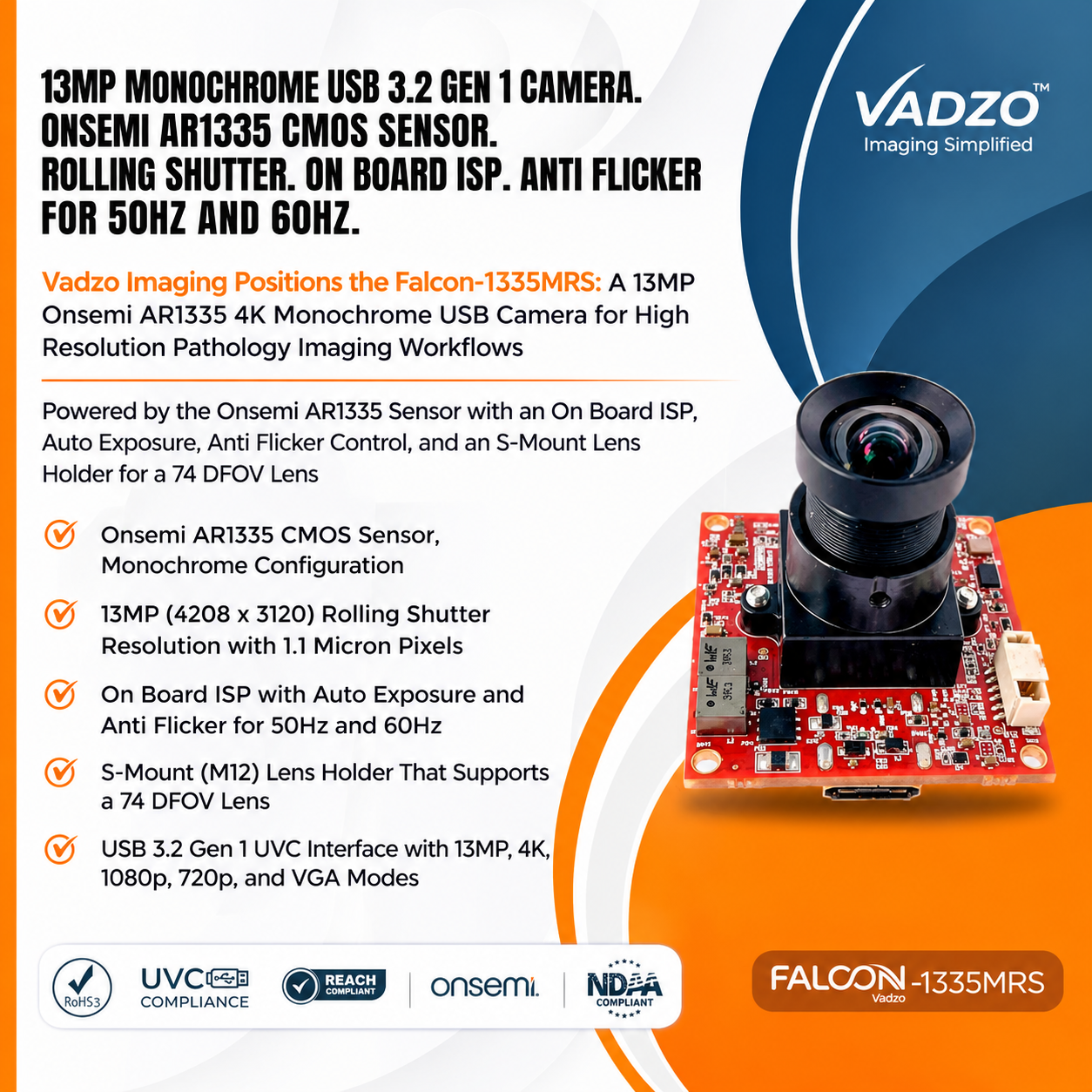

The Falcon-1335MRS is an Onsemi AR1335 13MP Monochrome USB 3.2 Gen 1 Camera, and Vadzo Imaging is positioning it for high-resolution pathology imaging workflows
FORT WORTH, TX, UNITED STATES, November 5, 2026 /EINPresswire.com/ — Vadzo Imaging, a provider of embedded vision camera products for OEMs and system integrators, positions the Falcon-1335MRS as a 13MP Monochrome USB 3.2 Gen 1 Camera for high-resolution pathology imaging workflows. Built on the Onsemi AR1335 sensor, the camera combines a monochrome rolling shutter sensor, on-board ISP, auto exposure, anti-flicker control, and an S-Mount lens holder supporting a 74 DFOV lens. As part of Vadzo’s USB camera portfolio, it is designed for laboratory instrument makers and workflow software teams that need detailed images of labels, cassettes, slides, and specimen trays. This positioning also considers lens selection, working distance, lighting, and integration requirements for laboratory stations.
Why a 13MP Monochrome USB 3.2 Gen 1 Camera Fits Pathology Imaging Workflows
Pathology laboratories handle specimens through several stages, including registration, grossing, cassette preparation, embedding, sectioning, slide mounting, staining, and review. Each stage requires accurate identification and documentation. Images of labels, barcodes, cassettes, slides, and trays can help connect physical specimens to their corresponding cases and support traceability.
Not every workflow image requires color. Stained tissue and gross specimens may need color information, but printed labels, barcodes, cassette numbers, and tray positions are primarily identified through shape and contrast. A monochrome camera captures these details without a color filter array or color interpolation, helping preserve fine character edges and barcode lines. Its high resolution also provides pixels for reading small labels and codes.
Laboratory lighting can introduce additional challenges. Fluorescent and LED fixtures may flicker at twice the mains frequency, creating dark bands in captured images. Exposure can also change when lighting conditions vary around a workstation. Auto exposure helps maintain suitable image brightness, while anti-flicker control supports operation under 50Hz and 60Hz lighting.
Integration is another important consideration. Instrument makers need a camera that connects through a standard interface and works with their host systems. Lens selection and mounting height must also match the target area. Testing real labels and slides at the intended working distance before finalizing a station can help avoid changes to the camera position or optics later.
How a 13MP Monochrome USB 3.2 Gen 1 Camera Serves a Pathology Workflow
The Falcon-1335MRS uses the Onsemi AR1335 13MP monochrome rolling shutter sensor, providing a maximum resolution of 4208 × 3120 pixels. The sensor has a 1/3.2-inch optical format and 1.1-micron back-illuminated pixels. Its monochrome design removes the color filter array, allowing more incoming light to reach the pixels. The rolling shutter readout is suitable for stationary laboratory objects when images are captured after the specimen or tray has settled.
An on-board ISP provides auto exposure and anti-flicker control. The module also includes an S-Mount (M12) lens holder supporting a 74 DFOV lens. Its 13MP resolution allows users to capture detailed frames and crop regions of interest when the application requires closer inspection.
A 74-degree diagonal field of view provides a practical reference for station planning. With this sensor, the lens has an approximate focal length of 3.8mm and a horizontal field of view of about 62 degrees. At a working distance of 200mm, the image covers approximately 240mm horizontally, providing around 17 pixels per millimeter. A standard 75 × 25mm glass slide would occupy approximately 1,300 × 440 pixels. These figures are illustrative and depend on the lens, actual mounting distance, and optical distortion. A wide lens is useful for close-range labels, cassettes, and small trays, while larger areas may require a different lens or mounting height.
Anti-flicker control helps address lighting variations. Mains-powered lighting commonly flickers at 100Hz on a 50Hz supply and 120Hz on a 60Hz supply. Matching exposure time to the flicker period can reduce visible banding. The ISP provides anti-flicker settings for these supply frequencies. Since monochrome images contain no color information, white balance is not applicable. Workflows requiring consistent brightness should keep lighting stable or record exposure settings with captured images.
The camera connects through USB 3.2 Gen 1 and supports UVC operation. It provides 13MP, 4K, 1080p, 720p, and VGA output modes for capture, preview, and alignment. Windows, Linux, and macOS hosts can use UVC-compatible operation without requiring a proprietary camera driver. Customers should confirm supported frame rates and output configurations against product documentation.
Station design also affects image quality. Glass slides and coverslips can reflect direct lighting, potentially hiding label details. Diffuse lighting, suitable camera positioning, and a matte background can reduce unwanted reflections. A rigid mount and repeatable slide or tray placement help maintain a consistent field of view. Vadzo can support customers during evaluation with lens and station-planning guidance.
Product Overview
The Falcon-1335MRS is a 13MP monochrome USB camera module built around the Onsemi AR1335 sensor. As a 13MP Rolling Shutter Monochrome USB Camera, it is positioned for stationary, high-resolution imaging tasks. Its on-board ISP processes images within the module, while auto exposure helps manage changing brightness. The camera also supports 4K output and uses an S-Mount lens holder compatible with a 74 DFOV lens.
The module serves applications requiring an AR1335 On-board ISP USB Camera, a 13MP Auto Exposure USB Camera, and a 4K Rolling Shutter Mono USB Camera. Its USB 3.2 Gen 1 UVC interface provides a standard connection for compatible host systems.
Key specs: 13MP (4208 × 3120) maximum resolution | Onsemi AR1335 1/3.2-inch sensor format | 1.1-micron pixels | Monochrome rolling shutter | USB 3.2 Gen 1 UVC interface | S-Mount (M12) optics supporting a 74 DFOV lens.
Key Capabilities of the 13MP Monochrome USB 3.2 Gen 1 Camera
Monochrome Sensor Output
The monochrome sensor has no color filter array, allowing more light to reach each pixel without color interpolation. This supports clear edges in small printed characters and barcode lines. It is suited to labels, cassettes, trays, and other tasks where contrast matters more than color. Stained tissue review requires a color camera, and laboratories can use separate monochrome and color modules for different workflow stages.
Rolling Shutter Readout
The sensor reads image rows sequentially, providing high-resolution capture for stationary objects. This is suitable for laboratory benches where slides and cassettes can remain still during capture. Fast movement during exposure may introduce skew, so a guide or resting position can help keep objects stable. Vadzo also offers global shutter modules for applications where motion during capture is a key concern.
On-board ISP
The integrated image signal processor processes images within the camera module. This reduces the need for host software to build an ISP pipeline for the sensor. The processed output supports integration into laboratory stations, while customers requiring raw sensor data or specialized image tuning can discuss alternative configurations with Vadzo.
Auto Exposure and White Balance Behavior
Auto exposure adjusts exposure time and gain as lighting changes, helping maintain suitable image brightness. White balance does not apply to monochrome output because the image contains no color channels. For consistent documentation, laboratories can maintain stable lighting or record exposure settings alongside captured images.
Anti-flicker for 50Hz and 60Hz Lighting
Fluorescent and LED lighting can produce bands when exposure timing interacts with the light’s flicker cycle. The ISP provides anti-flicker control for 50Hz and 60Hz lighting environments. Testing under the actual workstation lights helps confirm the required setting and image behavior.
S-Mount Lens Holder for a 74 DFOV Lens
The S-Mount (M12) lens holder supports a 74 DFOV lens for close-range imaging. At an illustrative working distance of 200mm, the lens covers approximately 240mm horizontally. This can accommodate a slide and its label, depending on positioning. Teams should select lens and mounting height together and calibrate for lens distortion when measurements are required.
13MP Resolution and Output Modes
The camera supports 13MP, 4K, 1080p, 720p, and VGA modes for image capture, live preview, and alignment. As a 13MP High Resolution USB Camera Module, it provides detailed image data for applications involving small labels and codes. Vadzo’s 13MP High Resolution USB Camera Portfolio supports OEM requirements, including lens matching, firmware customization, and enclosure design. Available modes and frame rates should be confirmed during evaluation.
“Pathology laboratories need reliable records of specimens, labels, cassettes, and slides throughout their workflows. Many of these documentation tasks do not require color. The Falcon-1335MRS is positioned for those requirements, combining a monochrome sensor, 13MP resolution, on-board ISP, auto exposure, and anti-flicker control. We also recognize that stained tissue review and whole-slide scanning require different imaging approaches. Our team helps customers evaluate lens selection, lighting, and station design so they can assess the camera under their actual operating conditions.” — Alwin Vincent, Product Manager, Vadzo Imaging.
Pathology Workflow Imaging Application
Medical Device and Patient Care
Pathology instruments and workflow stations can use cameras to document specimens, cassettes, blocks, slides, and trays. The Falcon-1335MRS can support label and barcode capture, specimen identification, and workflow documentation. It can also provide overview images that help locate slides before scanning. Diagnostic whole-slide imaging, however, requires suitable microscope optics and scanning mechanisms. Laboratories remain responsible for validating the finished instrument and meeting applicable regulatory requirements.
Kiosk and Digital Signage
Specimen intake counters and clinic kiosks can use camera modules to capture labels and requisition details as samples arrive. The camera’s 13MP output provides image detail for reading printed information on slides and containers. Systems that capture patient information should also follow appropriate privacy, access, and image-retention policies.
Security and Surveillance
Pathology and forensic laboratories may need visual records of specimen storage areas, receiving benches, and handling points. The camera can provide monochrome images of designated work areas, with auto exposure and anti-flicker control supporting changing lighting conditions. Operators should define camera coverage, access permissions, and retention periods for recorded material.
Retail Automation Solutions
Retail pharmacies and clinics that receive samples can use camera-based systems to document containers and labels at collection counters. A monochrome camera is suitable for reading printed identification details, while color cameras remain appropriate when color information is important. A workstation may use both camera types for different tasks.
Frequently Asked Questions
Q: Can a monochrome camera image stained pathology slides?
A: Stained tissue contains color information that may be important for review, so a monochrome camera is not the appropriate choice for color-based examination. It is better suited to label and barcode reading, cassette and tray documentation, and slide placement checks. Vadzo offers color camera modules for workflows that require color imaging.
Q: What is a 74-degree lens good for at a pathology bench?
A: A 74-degree lens provides a relatively wide view at close range. It can capture a slide with its label, a cassette, or a small tray, depending on working distance and mounting position. Actual coverage and detail depend on lens characteristics and station geometry. Testing with real labels is recommended, particularly when measurements are required.
Q: What does anti-flicker do in a laboratory?
A: Fluorescent and LED lighting can flicker at 100Hz on a 50Hz supply and 120Hz on a 60Hz supply. Incorrect exposure timing can create dark bands in images. Anti-flicker control helps match exposure to the lighting frequency and reduce these bands. Testing under the laboratory’s actual lights confirms the result.
Q: How can a camera help with specimen tracking?
A: A camera can capture labels, barcodes, cassettes, and trays at different workflow stages. Software can associate those images with the relevant case, helping staff review specimen movement and identify possible labeling or placement errors. Lens selection, lighting, mounting, privacy, and retention policies should be considered during station design.
Q: Why should laboratory instrument makers choose Vadzo Imaging as their 13MP Mono USB Camera Manufacturer?
A: Vadzo Imaging provides camera modules with an on-board ISP, auto exposure, anti-flicker control, and an S-Mount lens holder supporting a 74 DFOV lens. The team can also assist with lens selection, firmware customization, and enclosure design. Evaluation options allow instrument makers to test camera performance with real labels and slides before volume production.
Availability
The Falcon-1335MRS 13MP Monochrome USB 3.2 Gen 1 Camera, built on the Onsemi AR1335 sensor, is available for evaluation and production orders. Evaluation configurations can include the camera module, a 74 DFOV S-Mount lens, USB cable, and platform documentation, subject to confirmation. Laboratory teams can test label and barcode capture at their intended working distance, evaluate anti-flicker performance under their own lighting, and confirm exposure behavior before finalizing a production design.
Customers requiring a different lens or customized integration can contact Vadzo Imaging to discuss their requirements. Explore Vadzo’s range of high-resolution USB camera solutions at www.vadzoimaging.com or email support@vadzoimaging.com to request an evaluation unit or discuss OEM integration.
About Vadzo Imaging
Vadzo Imaging is a global provider of embedded vision solutions, offering camera technologies and imaging platforms for robotics, industrial automation, UAVs, edge AI, and medical systems. Its products are designed for integration with leading embedded platforms. Vadzo supports customers through hardware customization, firmware development, and module-level drivers across USB, MIPI, GigE, Wi-Fi, and SerDes camera interfaces.
Alwin Vincent
Vadzo Imaging
+1 817-678-2139
alwin@vadzoimaging.com
Visit us on social media:
LinkedIn
YouTube
X
Legal Disclaimer:
EIN Presswire provides this news content “as is” without warranty of any kind. We do not accept any responsibility or liability
for the accuracy, content, images, videos, licenses, completeness, legality, or reliability of the information contained in this
article. If you have any complaints or copyright issues related to this article, kindly contact the author above.

Media gallery